
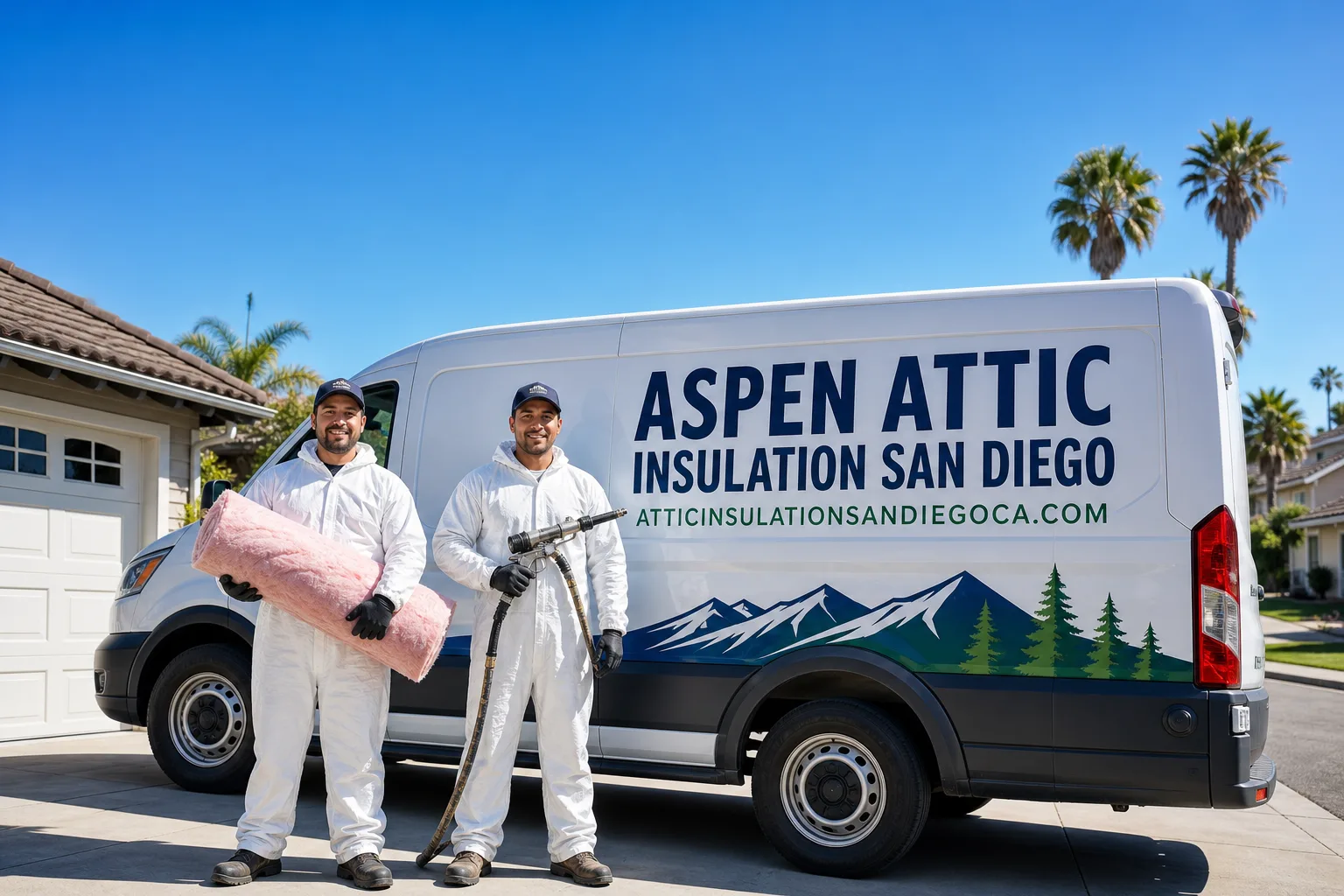
Trusted Spray Foam Insulation for San Diego Homeowners
How much Spray Foam Insulation costs in San Diego typically runs $2.50 to $6.50 per square foot installed, and most homes fall somewhere in the $1,800 to $7,200 range depending on the area being treated and the foam type. It seals air leaks that fiberglass simply can’t touch, which matters in a city where summer heat pushes attic temperatures past 140°F and winter nights along the coast drop into the 40s. Aspen Attic Insulation San Diego has been insulating homes since 2002, and our crews are in Clairemont, North Park, Rancho Bernardo, and every neighborhood in between on a regular schedule. Call (858) 282-0169 and a live person answers, day or night, to get your written price before any work starts.
Closed Cell Spray Foam Insulation
Closed Cell Spray Foam Insulation is the dense, rigid option that adds structural strength to the surfaces it coats while creating a complete air and vapor barrier at roughly 2 inches thick. We recommend it for San Diego homes where space is tight, like cathedral ceilings or shallow rim joists, because closed cell delivers R-6.5 to R-7 per inch, nearly double what open cell offers in the same space. It also stops moisture migration, which is important in coastal areas like Ocean Beach and Spray Foam Insulation - Coronado where salt air pushes humid conditions against framing year-round. Aspen Attic Insulation San Diego installs closed cell using Demilec and CertainTeed products matched to the specific cavity depth, with a typical cost of $3.50 to $6.50 per board foot applied.
Where Closed Cell Earns Its Price
At the rim joist line, in crawl space headers, and across garage ceilings that share walls with living space, closed cell pays for itself by stopping air movement that fiberglass can’t. We’ve pulled back old batt insulation in La Mesa and Bonita homes and found gaps big enough to slip a hand through where heat was pouring out all year. Closed cell seals those permanently.
Vapor Barrier Without a Separate Step
Because closed cell repels water and blocks vapor diffusion, San Diego homeowners skip the extra plastic sheeting step that fiberglass installations often require. That means fewer materials, fewer seams, and one crew handling the whole job cleanly. The result is a tighter assembly with fewer points of failure.
Open Cell Spray Foam
Open Cell Spray Foam is the lighter, softer insulation that expands to fill large cavities completely and delivers strong sound dampening along with solid thermal performance at R-3.5 to R-4 per inch. We install it most often in attic rooflines and above garage ceilings where there’s plenty of depth to work with and the homeowner wants sound control as much as temperature control. It’s also the more budget-friendly path, typically $2.50 to $4.00 per board foot, which makes it a smart choice for whole-attic applications in neighborhoods like Chula Vista and our Spray Foam Insulation in National City. Aspen Attic Insulation San Diego brings Icynene open cell foam when the job calls for maximum coverage at a lower material cost.
Air Sealing Without the Rigidity
Open cell foam expands dramatically after application, filling odd-shaped bays, around wiring, and into gaps that rigid boards can’t reach. In older San Diego homes built before 1980, those irregular cavities are everywhere, and open cell is forgiving enough to handle them without trimming or voiding. The result is a continuous air seal from eaves to ridge.
Sound Control for Busy Households
If a master bedroom sits over a garage, or a home office faces a busy street in Lemon Grove or El Cajon, open cell foam reduces noise transfer noticeably. We’ve had customers tell us they stopped hearing the garage door opener from the bedroom above after the install. That’s what full cavity fill does.
Spray Foam Insulation Contractors
Spray Foam Insulation Contractors are the licensed, trained crews who run the two-part foam rig, manage the temperature and pressure at the gun, and know how to cut and shape the foam for a clean finish. This is not a trade where experience is optional, because the chemistry and application technique directly determine whether the foam cures properly, adheres fully, and performs at its rated R-value. Aspen Attic Insulation San Diego operates to the Threshold Standard, which means every technician is background-checked, identity-verified, photo-badged, and sent to you by name and photo before the visit. Expect to pay $75 to $150 per hour for contractor labor within the overall project cost, and expect to see exactly what that labor covers in your written estimate.
The Threshold Standard Explained
Before any of our techs knocks on a door in San Diego, you’ll have their name and photo on your phone. They arrive in a clean marked uniform, and they show a photo ID badge at the door before stepping inside. If anyone other than that named tech arrives, the visit is free and we make it right, no questions asked.
Insurance, Verification, and Written Pricing
Every Aspen Attic Insulation San Diego job carries a written price delivered before any work starts, covering labor and materials with no post-job add-ons. Our techs are insured and bonded, and the 365-Day Done Right Promise backs every repair for a full year, with a free second visit if anything fails. That’s the only way we’ve operated since 2002.
Spray Foam Attic Insulation
Spray Foam Attic Insulation seals the attic floor or roofline so conditioned air stops escaping through the top of the house, which is the single biggest source of energy loss in most San Diego homes. When we apply foam to the roofline deck, the attic becomes a semi-conditioned space, which protects ductwork and keeps stored items from baking. A typical roofline application in San Diego runs $4,000 to $9,000, while a floor-sealing job often lands closer to $2,500 to $5,500. Aspen Attic Insulation San Diego uses GreenFiber and CertainTeed foam products depending on whether the homeowner wants the attic ventilated or sealed.
Roofline vs. Floor: What Changes the Price
Sealing the roofline means covering every rafter bay from eaves to peak, which uses more material but turns the attic into usable or at least stable square footage. Sealing the attic floor is less expensive and still stops the stack effect, where hot air rises and pulls cool air in through gaps downstairs. We walk through both options in the written estimate so you decide with real numbers in front of you.
Duct Protection in Hot Attics
San Diego attics hit 140°F in August, and HVAC ducts sitting in that heat lose a measurable percentage of their cooling before air ever reaches a bedroom. Foam at the roofline brings that attic temperature down by 30 to 50 degrees, which means your AC doesn’t work as hard. That’s the efficiency gain most homeowners feel in their first summer bill.
Spray Foam Wall Insulation
Spray Foam Wall Insulation fills the wall cavity completely from the exterior sheathing to the interior drywall, stopping air movement and adding R-value in a single application. That’s the difference maker in San Diego because our mild climate means walls often have no insulation at all in homes built before the 1978 building code changes, especially in neighborhoods like North Park, Normal Heights, and La Mesa. Wall foam installation typically costs $3.00 to $5.50 per square foot of wall area when done during construction or a remodel, and slightly more when we’re retrofitting through existing drywall. Aspen Attic Insulation San Diego handles both new-construction and retrofit wall foam.
Retrofit Through Existing Walls
When the walls are already closed up, we inject foam through small access holes drilled in the drywall or from the exterior, then patch and match the finish. It’s a cleaner process than most homeowners expect, and it’s the only way to get full-cavity insulation into an older San Diego home without tearing walls down. The air-sealing benefit alone usually covers the cost of the project within several years.
New Construction and Remodel Walls
For walls that are still open framing, foam goes in fast and cures in minutes, so the drywall crew can stay on schedule. We work with general contractors across San Diego to hit R-21 or higher in 2×6 walls, and we provide the documentation and materials labels so the inspection passes without delays.
Rim Joist Spray Foam
Rim Joist Spray Foam seals the perimeter of the floor system where the foundation meets the first floor, the spot where cold air, insects, and moisture sneak into the house from below. It’s a small area, usually 100 to 200 linear feet around the foundation, but it’s responsible for a disproportionate share of air leakage in homes throughout San Diego. We typically charge $800 to $1,800 for a full rim joist seal using closed cell foam, which acts as both air barrier and vapor barrier. Aspen Attic Insulation San Diego treats this as a targeted job, not an upsell, because it’s one of the highest-ROI insulation fixes available.
Why the Rim Joist Leaks More Than You Think
Builders in San Diego often stuffed fiberglass batts into rim joist bays and called it done, but fiberglass doesn’t stop air movement. Every gap between the foundation and the framing pulls outside air into the floor system, and that air rises through the house. Closed cell foam adheres to the concrete and the wood, forming a permanent seal that fiberglass can’t match.
Insect and Moisture Resistance at the Foundation Line
Closed cell foam has no food value for pests and it won’t wick or hold water, so it’s the right product where wood sits near concrete. In crawl spaces around La Presa and Eucalyptus Hills, we’ve seen rim joists that were damp for years because outside air was condensing against the framing. Foam stops the air movement, and the condensation stops with it.
Crawl Space Spray Foam Insulation
Crawl Space Spray Foam Insulation lines the crawl space walls or the floor system above to break the connection between damp, unconditioned air below the house and the living space above. Homes on pier-and-beam foundations in San Diego’s older neighborhoods, from Golden Hill to Bonita, deal with this constantly, and the result is cold floors in winter and musty air rising into the house all year. Expect to pay $2,000 to $5,000 for a full crawl space encapsulation using closed cell foam, depending on access and square footage. Aspen Attic Insulation San Diego uses Demilec closed cell foam in crawl spaces because it handles ground moisture without degrading.
Encapsulation vs. Floor Insulation
Encapsulating the crawl space walls keeps the entire volume below the house conditioned, which protects ducts and plumbing and makes the crawl space dry enough to store things. Insulating only the floor above is cheaper but leaves the crawl space damp and still lets outside air into the vents. We present both options with honest pricing and explain what each one gets you.
Duct and Pipe Protection Below the House
Ductwork running through an unconditioned crawl space loses temperature through the metal, especially when the ground below is damp and cool. When the crawl space is sealed with foam, that ductwork sits in air that’s 20 to 30 degrees more stable, reducing the load on your HVAC system. The pipes are less likely to sweat too, which reduces corrosion over time.
Garage Spray Foam Insulation
Garage Spray Foam Insulation seals the garage ceiling and the shared wall between the garage and the house, so the living space doesn’t lose heat through the garage on cold nights or gain it back on hot afternoons. If you have a bedroom above the garage in San Diego, that floor assembly usually has zero air sealing and very little insulation. A typical garage ceiling and shared wall job runs $1,500 to $3,500, depending on whether we’re foaming the ceiling only or the shared wall too. Aspen Attic Insulation San Diego applies open cell foam to the garage ceiling in most cases because it fills the joist bays fully and cuts the noise from openers and tools.
Bedrooms Above the Garage: The Cold Spot Problem
The bedroom over the garage is almost always the hardest room in a San Diego house to keep comfortable, and it’s usually because the garage below acts like an unconditioned attic. Foaming the garage ceiling stops the heat exchange between the garage and the bedroom floor, so the room above stays within a few degrees of the rest of the house. We hear back from homeowners within weeks that the room finally feels the same as the hallway.
Carbon Monoxide and Air Sealing
Any time we seal a garage, we’re also sealing the boundary between car exhaust and living air. Foam at the shared wall and ceiling reduces the pathways where carbon monoxide can migrate into the house, especially in attached garages where the door to the kitchen is used dozens of times a day. That’s a safety improvement, not just an energy improvement.
Brands We Service
We install and service spray foam from CertainTeed and Icynene, two of the most established names in the insulation trade. CertainTeed’s closed cell foam is a daily driver for our rim joist and crawl space work because it cures hard, adheres aggressively, and holds its R-value in the damp conditions we see under San Diego homes. Icynene’s open cell foam is our go-to for attic rooflines and garage ceilings where full cavity fill and sound control matter more than rigidity.
We also work regularly with Demilec products, which makes sense in coastal neighborhoods like Point Loma and Imperial Beach because Demilec’s closed cell chemistry handles humid, salt-air conditions without losing performance. Whether you have a specific brand in mind or you’d rather we match the product to the problem, we’ll show you the material spec and the price in writing before any foam is mixed.
Signs You Need a Pro Right Now
- Uneven room temperatures between floors. If your upstairs is 8 degrees warmer than your downstairs on a summer afternoon, the attic or wall cavities are likely leaking air. That temperature spread is the clearest signal in San Diego that your insulation envelope has failed somewhere specific, and a pro can pinpoint it with a blower door or thermal camera, not guesswork.
- Utility bills that climb every summer without a change in usage. SDG&E rates have risen steadily, but if your kilowatt-hour usage goes up year over year while your habits stay the same, you’re conditioning air that’s escaping. Spray foam addresses the leaks that fiberglass can’t, and the bill drop usually shows up within the first billing cycle after the job.
- Musty smells or dampness in the crawl space or basement. Damp, unconditioned air under the house wicks up through floor framing and carries that smell into the living space. Closed cell foam at the crawl space walls or rim joist stops the air movement that brings the moisture in, which also protects the framing from rot and mold over time.
- Rodents or insects making their way in through the foundation line. Gaps around the rim joist are the main entry point for pests in pier-and-beam homes across San Diego County. Closed cell foam seals those gaps tightly, and because it has no food value, it doesn’t become a nesting material the way fiberglass sometimes does.
- Rooms over the garage that never hold their temperature. The floor assembly above a garage usually has no air sealing at all, which means the garage’s temperature is basically the bedroom’s floor temperature. If that room swings 10 degrees from day to night while the rest of the house holds steady, the garage ceiling foam is the fix.
Our Process, Step by Step
- 1
Written estimate sent before the visit. When you call (858) 282-0169, you’ll speak to a live person who asks about the square footage, the space you’re targeting, and any comfort problems you’ve noticed. We send a written price based on that conversation before any tech arrives, so there’s no pressure to sign for a number you haven’t seen.
- 2
Named tech arrives with photo ID. The technician who shows up at your door is the same person whose name and photo were sent to you in advance. They arrive in a clean marked uniform, present a photo ID badge before entering, and walk the space with you to confirm the scope matches the quote.
- 3
Site prep and full protection of your home. We seal off the work area with plastic sheeting, cover any stored items, and run the foam rig with proper ventilation. Spray foam application is precise work, and our techs mask, trim, and shape the foam for a clean finish, not a lumpy afterthought.
- 4
Foam application and expanded coverage. The two-part foam is mixed at the gun and applied to the target surface, where it expands to fill the cavity and cures within minutes. For closed cell, we build to the specified depth for the R-value you paid for. For open cell, we fill the cavity fully and trim any excess flush.
- 5
Final walkthrough and guarantee in writing. After the foam cures and the area is cleaned, the tech walks you through the finished work, shows you the coverage and depth, and leaves you with the 365-Day Done Right Promise in writing. If anything fails within that year, we return and make it right at no cost to you.
How Much Does Spray Foam Insulation Cost in San Diego?
Spray foam insulation in San Diego runs $2.50 to $6.50 per board foot depending on foam type, and most whole-attic or crawl space jobs land between $2,000 and $7,200. A rim joist seal is the most affordable entry point at $800 to $1,800, while a full roofline application in a 1,500-square-foot home usually falls in the $4,000 to $9,000 range. Wall foam during a remodel typically costs $3.00 to $5.50 per square foot of wall area.
What moves the price is the depth of foam required, the accessibility of the space, and whether you’re using open cell or closed cell. Closed cell costs more per board foot but delivers nearly twice the R-value per inch, so the total cost between the two often ends up similar once you target the same performance. The best way to avoid overpaying is to get a written price that breaks down material, labor, and coverage area instead of a single lump number with no detail. Our free estimates include that breakdown, line by line, and the price we quote is the price you pay, no surprises after the foam is sprayed.
Our Service Area Near San Diego
Aspen Attic Insulation San Diego serves the entire San Diego metro area, including Chula Vista, National City, La Presa, Lemon Grove, Casa de Oro-Mount Helix, Jamul, Eucalyptus Hills, Bostonia, Coronado, La Mesa, and Bonita. Our techs are scheduled locally, so same-week appointments are standard and same-day availability is common for smaller jobs like rim joist sealing. If you’re in any of these communities and need spray foam insulation, call (858) 282-0169 and our team will confirm the next open slot on the phone, right then.
Serving San Diego, CA - Our Local Coverage Area
We’re based in the Spray Foam Insulation in San Diego area and know this community well. Use the map below to see our service coverage - if you’re nearby, we can almost certainly help.
Frequently Asked Questions About Spray Foam Insulation in San Diego
Spray foam insulation is a two-part liquid that expands on contact to fill cavities and seal air leaks, creating an air barrier and thermal barrier in one step. It can be open cell, which is softer and fills large areas, or closed cell, which is rigid and acts as a vapor barrier too. It’s the most effective insulation for stopping air movement, which is how most heat enters and leaves a San Diego home. Compared to fiberglass batts, spray foam typically reduces air leakage by a measurable margin that shows up in your utility bills within the first season.
Most rim joist jobs are done in 3 to 4 hours, and a typical attic roofline application takes one full day. Larger jobs that combine multiple areas, like a crawl space encapsulation plus a rim joist seal, usually run a day and a half. The foam itself cures within minutes, so you can be back in the space the same day. Call (858) 282-0169 for an exact timeline for your specific project, and the estimate is free.
Spray foam insulation in San Diego costs $2.50 to $6.50 per board foot, with most whole-space projects falling between $2,000 and $7,200. Small, targeted jobs like rim joist sealing can be under $1,800. Your written estimate will show the material cost, labor, and coverage area separately so you know exactly what you’re paying for. Call (858) 282-0169 for a free, no-obligation quote for your square footage.
Yes, Aspen Attic Insulation San Diego installs and services spray foam from CertainTeed, Icynene, and Demilec, along with other premium brands. We match the product to the specific space and performance target, not the other way around. If you already have spray foam installed and it’s underperforming, we’ll inspect it and tell you honestly whether it needs repair or replacement.
We’re available 24/7 by phone, and a live person always answers, not a voicemail loop. If you’ve had a water leak that soaked your insulation, or you’ve discovered a pest problem that tore through your existing batts, we can schedule a priority visit, often the same day or next morning. Call (858) 282-0169 and explain the situation, and we’ll get a tech to you as fast as the schedule allows.
The 365-Day Done Right Promise covers labor and materials for a full year after the install, and it’s delivered in writing on every job. If any part of the spray foam installation fails within that year, a second visit is free and we make it right at no cost to you. That’s the guarantee Aspen Attic Insulation has stood behind since 2002, and we’ve never wavered on it.
Clear the work area of any stored items, and if you have a crawl space or attic, move anything you want to keep away from the access point. Our techs handle full site protection with plastic sheeting and drop cloths, so you don’t need to cover furniture. Just be home for the first 15 minutes so the named tech can walk the scope with you, then you’re free to go about your day.
Schedule Your Spray Foam Insulation Service in San Diego Today
Call Aspen Attic Insulation San Diego at (858) 282-0169 for a free, no-obligation estimate on your spray foam insulation project. You’ll get a written price before any work starts, a named technician with a photo ID scheduled for the visit, and the 365-Day Done Right Promise in writing on every job. Our San Diego team is ready to seal your attic, walls, crawl space, or rim joist and start saving you money on utilities from the first month.
Written by Garrett Sloane, Owner at Aspen Attic Insulation San Diego, serving San Diego since 2002.